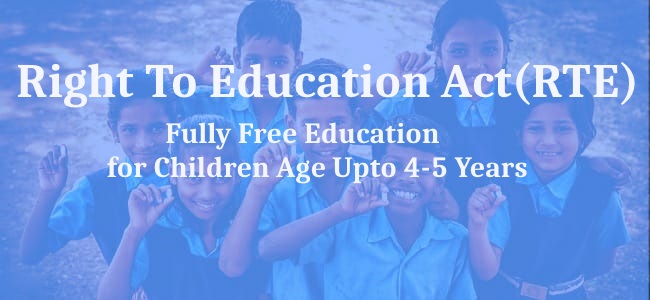
The Right of Children to Free and Compulsory Education Act or Right to Education Act (RTE), is an Act of the Parliament of India enacted on 4 August 2009, which describes the modalities of the importance of free and compulsory education for children between 6 and 14 in India under Article 21-A of the Indian Constitution. India became one of 135 countries to make education a fundamental right of every child when the Act came into force on 1 April 2010 and made India, one of those countries which consider education as a fundamental human right.

This Act makes education as a crucial right of each and every individual between the ages of 6 and 14 and determines least standards in primary schools. It requires all tuition based schools to hold 25% of seats for children (to be repaid by the state as a feature of the public-private organization plan). Children are conceded in to non-public schools in view of financial status or rank based reservations. It likewise disallows all unnoticed schools from training, and makes arrangements for no gift or capitation expenses and no meeting of the youngster or parent for affirmation. The Act likewise gives that no child will be kept down, ousted, or expected to breeze through a board assessment until the consummation of rudimentary schooling. There is likewise an arrangement for extraordinary preparation of school quitters to carry them satisfactory with understudies of a similar age.
RTE INCLUDES –
(1) Right to child for free and compulsory education till the completion of elementary schooling.
(2) It explains that ‘necessary training’ signifies commitment of the fitting government to give free elementary schooling and guarantee obligatory affirmation, participation and fulfillment of elementary instruction to each child in the six to fourteen age bunch. “Free” implies that no child will be at risk to pay any sort of charge or charges which might keep the person in question from chasing and finishing elementary training.
(3) It makes arrangements for a non-conceded child to be included to an age suitable class.
(4) It determines the obligations of proper implementation of act by Governments, neighborhood authority and guardians in giving free and obligatory training, and dividing of monetary and different obligations among the Central and State Governments.
(5) It sets out the standards and principles related to Pupil Teacher Ratios (PTRs), structures and foundation, school-working days, educator working hours.
(6) It provides for rational deployment of teachers by ensuring that the specified student teacher ratio is maintained for each school, rather than just as an average for the State or District or Block, thus ensuring that there is no urban-rural imbalance in teacher postings. It also provides
for prohibition of deployment of teachers for non-educational work, other than decennial census, elections to local authority, state legislatures and parliament, and disaster relief.
(7) It accommodates arrangement of fittingly prepared educators, for example educators with the essential passage and scholastic capabilities.
(8) It prohibits (a) physical punishment and mental harassment; (b) screening procedures for admission of children; (c) capitation fee; (d) private tuition by teachers and (e) running of schools without recognition,
(9) It accommodates advancement of educational plan in consonance with the qualities revered in the Constitution, and which would guarantee the overall improvement of the child, expanding on the
child’s knowledge, probability and ability to making the child liberated from dread, injury and uneasiness through an arrangement of child cordial and child focused learning.
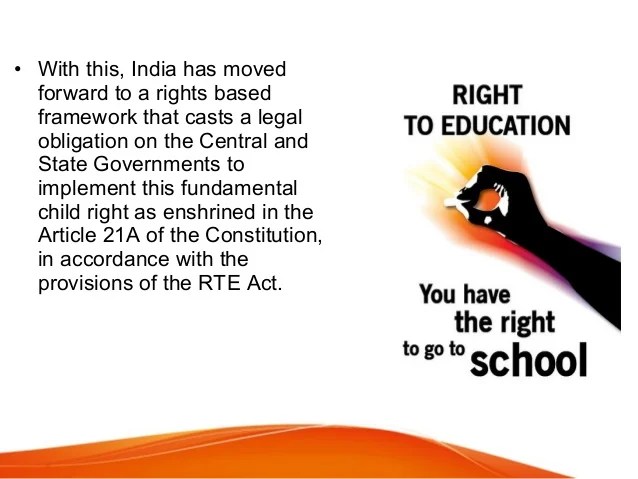
It is an important initiative in the education system of India, but for its complete and successful implementation we need to be aware and spread the word as well. For example, without knowing about any of the fundamental human right we can’t use it. We need to keep on check-in with the surroundings, so that we are able to make our ground realities as same as our books.
Thankyou! Happy Reading
Love Srishti
Reference – https://dsel.education.gov.in/rte
Photos taken from Google search. Thankyou to all the creators who have shared these pictures.

 Srishti Sangwan
Leave a comment